Senado Square: The Heart of Macau's Old Town
Explore Senado Square in Macau, the wave-patterned Portuguese plaza at the center of the UNESCO-listed old town, with its colonial buildings, bakeries and nearby churches.

Senado Square: The Heart of Macau's Old Town
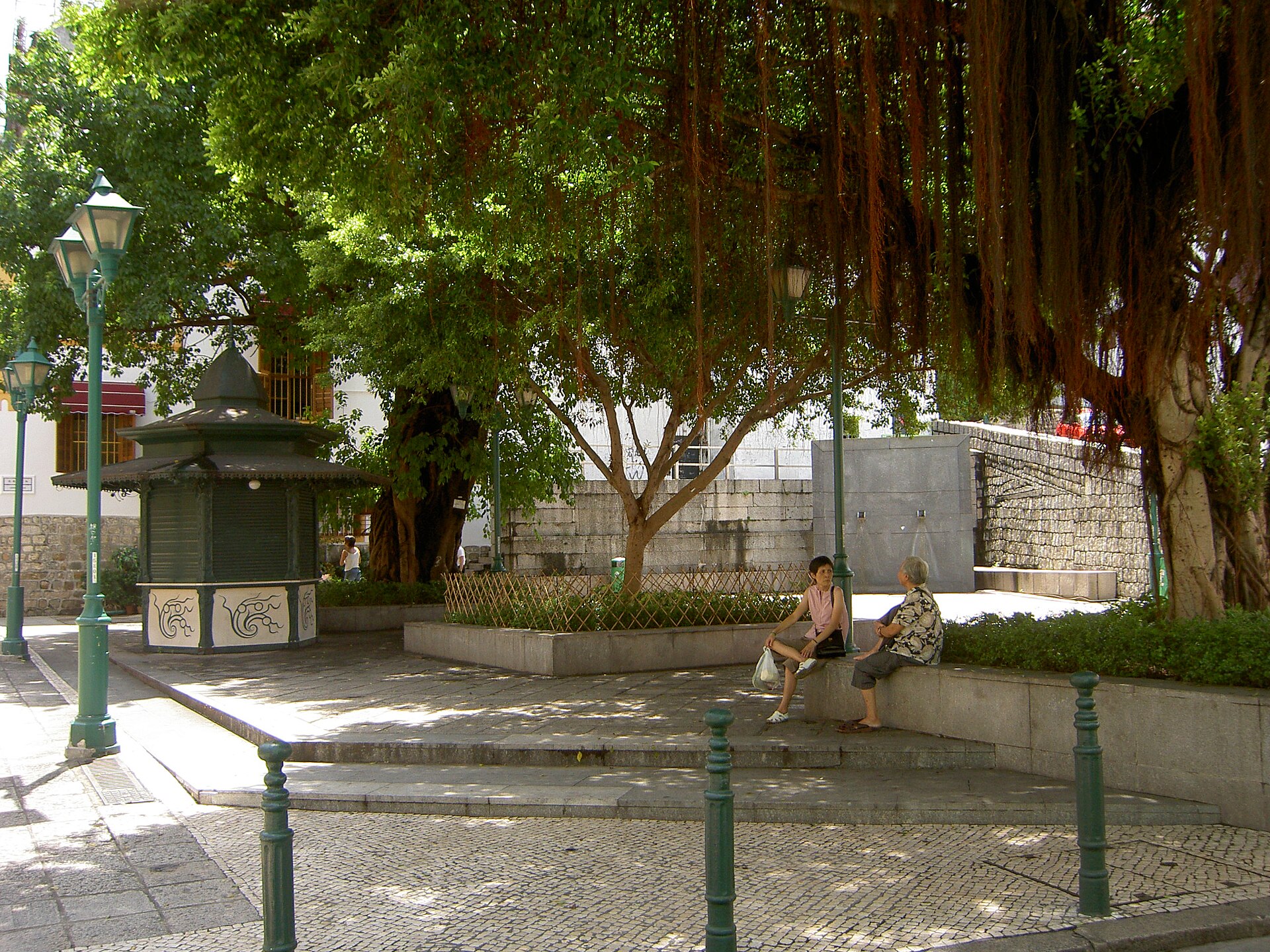
Senado Square, or Largo do Senado in Portuguese, is the central plaza of Macau's old town and the natural starting point for any walk through the Historic Centre of Macao. Paved in a wave pattern of black and white stones in the Portuguese calçada style, it is ringed by pastel-colored colonial buildings with white trim and green shutters, and it feels deliberately closer to southern Europe than to anywhere else in China. It is one of the most photographed places in the territory, and it is busy from morning until night.
The square takes its name from the Leal Senado, the Loyal Senate, a neoclassical building at its southern end that served as the seat of Portuguese local government for centuries and now houses the Macau Municipal Affairs Bureau and a small public library. Its courtyard and garden are open to visitors and are one of the quieter spots nearby. Directly opposite, the Holy House of Mercy, one of the oldest charitable institutions in Asia, occupies a handsome building that now includes a small museum.
A short walk from the square, narrow streets lead past a string of colonial churches. St. Dominic's Church, with its creamy yellow baroque façade and white stucco interior, is the closest and one of the most beautiful, and the Cathedral of the Nativity of Our Lady and St. Lawrence's Church are within easy walking distance as well. The streets are lined with the original shopfronts and the red and green street signs in both Chinese and Portuguese that give the old town its distinctive character.
Shopping and eating are a big part of the visit. The lanes radiating from the square are full of shops selling almond cookies, jerky and dried meats, egg tarts and other Macanese snacks, many of them handing out free tastes to passers-by. Prices are usually fair, and buying boxes of cookies to take home is a local tradition. For something more substantial, small restaurants in the side streets serve pork chop buns, Macanese dishes and Cantonese noodle soups at reasonable prices.
| Sight | What to Know |
|---|---|
| Leal Senado | Neoclassical former senate building with a small courtyard and garden |
| Holy House of Mercy | One of Asia's oldest charities, with a small museum |
| St. Dominic's Church | Yellow baroque church a minute's walk from the square |
| Shopping streets | Almond cookies, jerky, egg tarts and souvenirs, with free tastes |
Senado Square is a short walk from the major bus stops on Avenida de Almeida Ribeiro, and many resort shuttles drop off nearby. From the ferry terminals take a bus or taxi and ask for “Senado.”
In the evenings and on weekends the square becomes a gathering place, with street performers, tour groups and local families all sharing the open space. It is lit in the evening, and the buildings take on a warm glow that makes it especially photogenic after dark. Festivals and cultural events are often held here, particularly around Chinese New Year, when the square is decorated with lanterns and large installations, and the crowds can be extremely dense.
The square is also a good place to understand Macau's history on foot. The surrounding buildings represent more than four centuries of Portuguese presence, mixed with Chinese influence, and the old town's streets show how the two communities lived side by side. Information plaques in several languages explain the main buildings, and guided walking tours depart from the area daily, though the old town is compact enough to explore on your own with a map.
Practical considerations are straightforward. The square is pedestrianized and flat, so it is easy for most visitors, but the streets that lead from it to the Ruins of St. Paul's and other sights are narrow and crowded in the middle of the day. Late afternoon and early evening are the most atmospheric times, when the light softens and the day-trippers begin to leave. Free luggage storage is not generally available, so travel light.
If you have only a few hours in Macau, Senado Square and the streets around it give you the most concentrated dose of what makes the city distinctive. It is easily combined with the Ruins of St. Paul's and Monte Fort in a half-day walk, and with a meal of Macanese food, it makes a complete introduction to the old town that is both rewarding and affordable.
It also helps to know a little about the events that fill the square. Chinese New Year brings lanterns and lion dances, Catholic and Buddhist processions pass through the old town on set dates, and arts festivals use nearby open spaces for performances. If your trip coincides with one, the atmosphere is far livelier than usual, though crowds and hotel prices rise accordingly. Outside festivals, the quietest hours are before ten in the morning, when shopkeepers are still opening and the pavement is nearly empty, which is ideal for photographing the wave-patterned stones without a crowd in the frame.