Vernissage Market: Yerevan's Open-Air Treasure Hunt
Browse Vernissage, Yerevan's sprawling open-air market for handwoven carpets, Soviet antiques, and Armenian crafts, busiest and best on weekend mornings.

Vernissage Market: Yerevan's Open-Air Treasure Hunt
Vernissage is Yerevan's best-known open-air market, a sprawling, informal bazaar running along Aram and Buzand streets just steps from Republic Square. Roughly 350 meters long at its core but branching into a maze of side stalls and side streets, Vernissage has become the default destination for anyone hunting for handwoven carpets, Soviet-era antiques, hand-carved wooden backgammon sets, or genuinely unusual souvenirs that go well beyond the standard magnet-and-postcard fare found elsewhere in the city. Locals and visitors alike use the French-derived name, a nod to the market's origins as an outdoor art exhibition rather than a conventional flea market.
The market's roots trace back to the 1980s, when Armenian artists began informally displaying their paintings and sculptures in the square beside the Artists' Union of Armenia, creating a spontaneous open-air gallery rather than a planned commercial venture. Some sources trace organized trading on the site even earlier, to the 1960s, but it was during the late Soviet period that Vernissage truly took shape as a public institution, gradually shifting its location and expanding in scope as more vendors, and more categories of goods, joined the original artists. What began as a handful of painters showing canvases has since grown into one of the largest open-air markets in the South Caucasus.
Today's Vernissage divides loosely into sections, though the boundaries blur and shift from week to week. Carpets and textiles form one of the market's most photographed corners, with vendors hanging dozens of handwoven rugs, some new and some genuinely antique, from tree branches and improvised racks, creating dense, colorful walls of pattern that draw photographers as much as buyers. Elsewhere, tables groan under Soviet military medals, cameras, gramophone records, crystal glassware, and painted porcelain figurines, remnants of a recent past that Vernissage has quietly become one of the best places in the region to browse. Wood carvers sell duduk instruments, chess sets, and backgammon boards carved from local timber, often while working on new pieces right at their stalls.
| Category | What to Look For | Typical Price Range |
|---|---|---|
| Carpets and rugs | Handwoven wool, traditional Armenian patterns | Wide range, bargaining expected |
| Soviet antiques | Medals, cameras, glassware, porcelain | Modest, varies by rarity |
| Wood crafts | Backgammon sets, duduks, carved boxes | Affordable, good gift options |
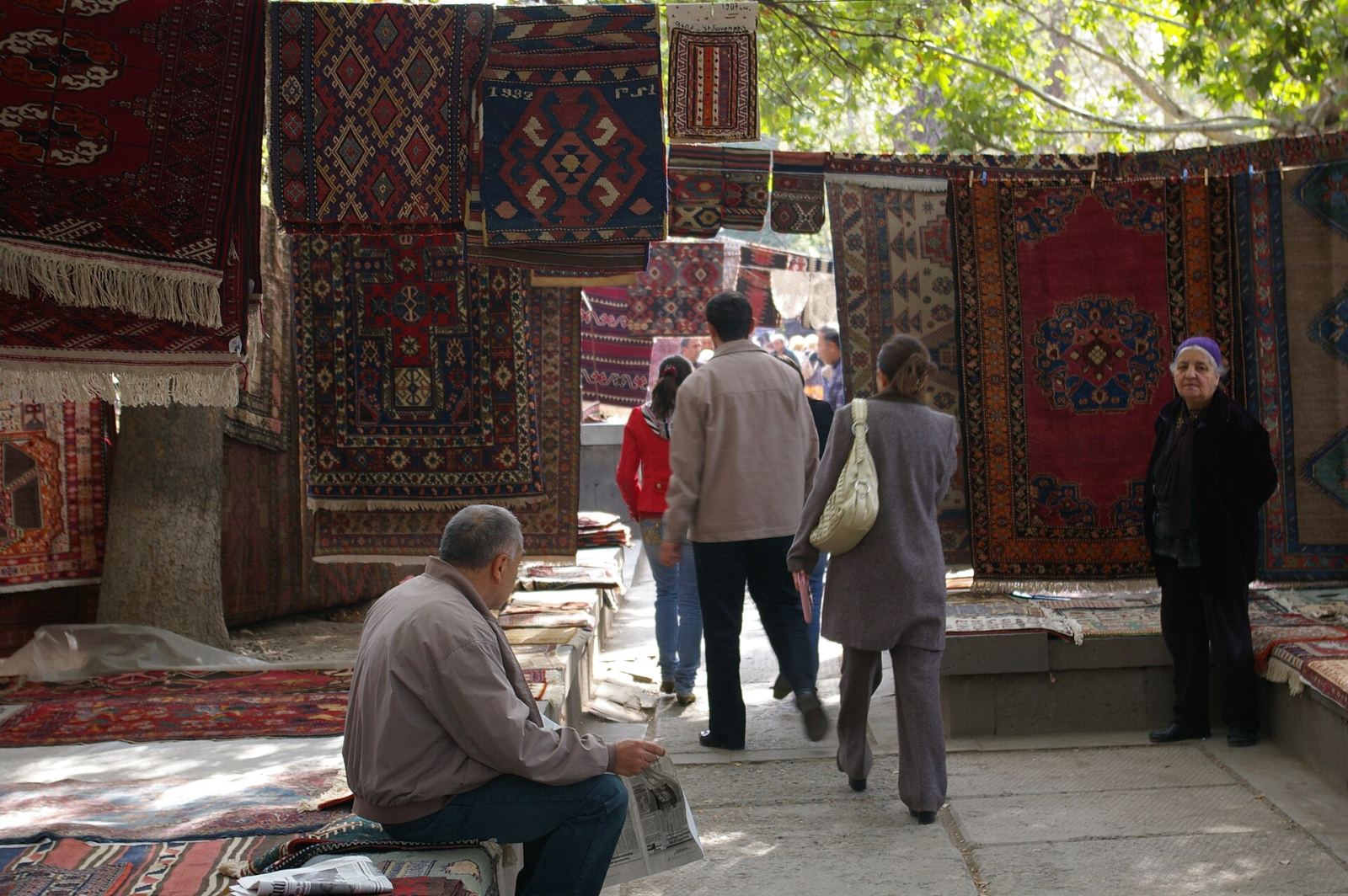
Vernissage operates in a smaller form throughout the week but reaches its full size and variety on Saturdays and Sundays, when the greatest number of vendors set up and the market spreads furthest into the surrounding streets.
Bargaining is an expected and normal part of shopping at Vernissage, though it tends to be good-natured rather than aggressive, and most vendors will meet a reasonable counteroffer somewhere in the middle without much fuss. Cash, generally in Armenian dram, is the standard payment method throughout the market, and while some larger carpet dealers may accept cards, it's safer to arrive with enough cash for whatever you're hoping to buy. Because the market operates largely outdoors and depends on good weather to draw its full range of vendors, a sunny weekend morning consistently offers the richest and most varied browsing experience.
Beyond the goods themselves, Vernissage functions as something of a living museum of Armenian material culture, where a single stroll down one row might pass Bronze Age-style pottery reproductions, mid-century Soviet propaganda posters, and contemporary handicrafts made by artisans working just a few feet from their finished wares. Many longtime vendors are happy to talk about the history or technique behind a piece if a customer shows genuine interest, turning a simple purchase into something closer to a short lesson in Armenian craft traditions, particularly around carpet weaving, an art form with roots stretching back thousands of years in the region.
Photography is generally welcomed throughout Vernissage, and the market's dense visual texture, hanging carpets, stacked antiques, and vendors mid-conversation, makes it one of the more rewarding places in Yerevan for street photography, though it's polite to ask before photographing a vendor directly rather than just their goods. Many visitors find that the most memorable purchases at Vernissage are not the largest or most expensive items but small, easily packed pieces, a hand-carved chess piece, a vintage postcard, a small woven textile, that carry an outsized story once you're back home and recall exactly where and from whom they came. Setting a rough budget before arriving also helps, since the sheer range of goods on offer, from ten-dollar trinkets to museum-quality antique carpets, makes it easy to lose track of spending amid the excitement of browsing.
Vernissage is located immediately adjacent to Republic Square, making it one of the easiest sights in Yerevan to reach on foot from almost any central hotel or landmark, typically within a five to ten minute walk. There is no fixed entrance or admission fee, since the market simply occupies open plazas and closed-off street sections, so visitors can wander in and out freely at whatever pace suits them. Comfortable shoes are worth wearing given the market's size and the amount of walking involved in seeing even a fraction of what's on offer, and setting aside at least an hour, rather than rushing through in twenty minutes, makes a real difference in how much of the market you actually take in and enjoy, especially once you factor in the time it takes to properly examine a carpet, ask a vendor about its origin, and negotiate a fair price without feeling rushed.