Angkor Thom and the Bayon: The Temple of Smiling Faces
How to visit Angkor Thom and the Bayon, from the gates lined with giant statues to the 200 smiling faces, the Elephant Terrace and the Baphuon, with tips on timing and tickets.
Angkor Thom: The Last Great Khmer Capital
Angkor Thom, meaning great city, was the final capital of the Khmer Empire and one of the largest cities in the medieval world. King Jayavarman VII built it in the late 12th and early 13th centuries after the Cham armies had sacked the earlier capital, and he enclosed a square of 9 square kilometers within walls 8 meters high and a moat 100 meters wide. Five monumental gates give access to the city, each topped by four huge stone faces and lined with rows of giant statues of gods and demons pulling a naga serpent. The south gate is the most photographed, and the main road from Angkor Wat enters through it.
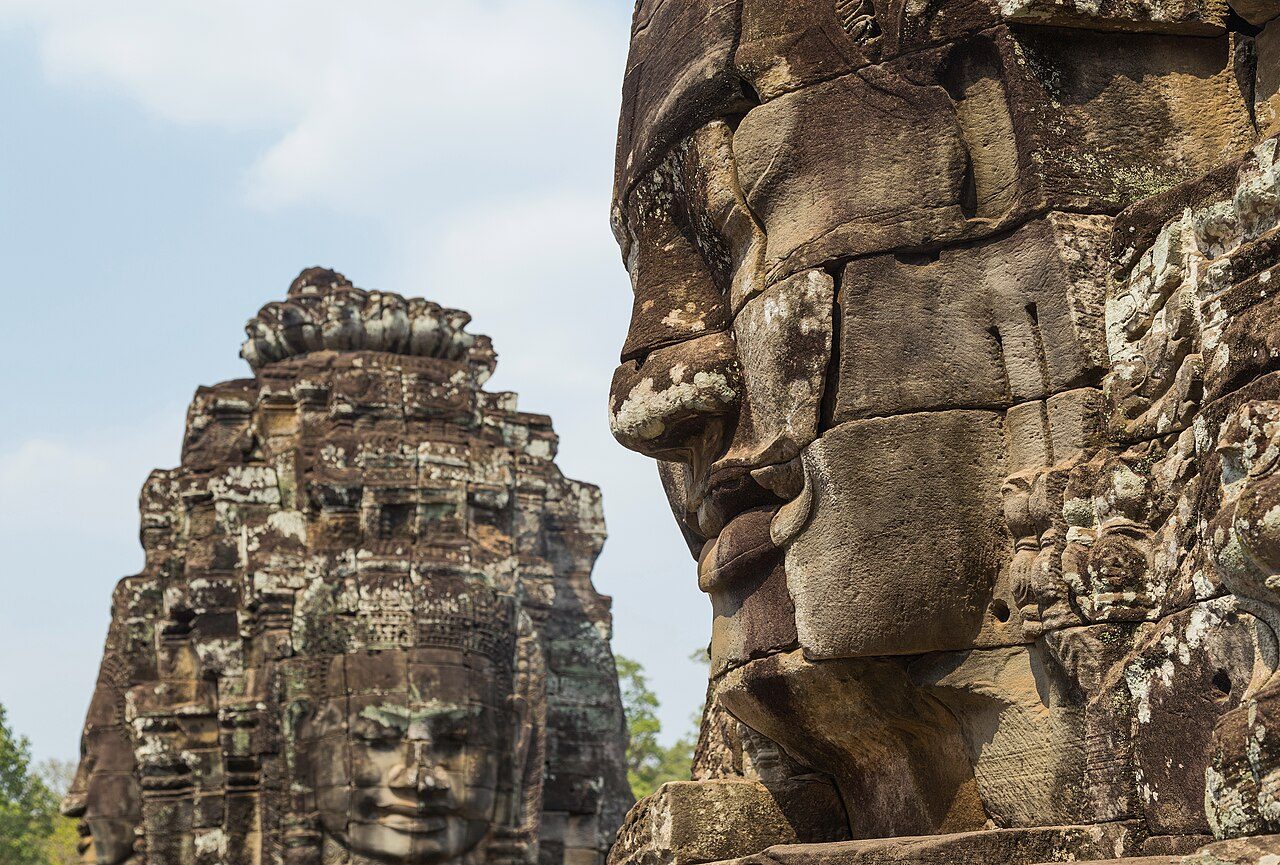
At the center of the city is the Bayon, the most extraordinary temple in Angkor. Its 54 towers carry more than 200 giant smiling faces, each with a serene expression, which are believed to represent the king himself as a Buddhist bodhisattva or the compassionate Avalokiteshvara. Walking among the towers, where the faces gaze at you from every angle, is a strange and moving experience. The lower galleries hold bas-reliefs that show scenes of everyday Khmer life, such as markets, fishing, cockfights and battles, which are livelier and more human than the epic scenes at Angkor Wat.
Visiting Angkor Thom and the Bayon
| Detail | Info |
|---|---|
| Best Time to Visit | Early morning, when the soft light shines on the faces, or late afternoon after the tour groups have left |
| Cost | Included in the Angkor Pass, valid for one, three or seven days |
| Location | About 1.7 kilometers north of Angkor Wat and 8 kilometers from Siem Reap town |
| How Long | Allow two to three hours for the Bayon, the Elephant Terrace and the Baphuon |
Making the Most of the Visit
Beyond the Bayon, Angkor Thom holds several other sights that are worth seeing. The Terrace of the Elephants, a 350-meter-long platform decorated with carvings of elephants, was used by the king to review his troops. The Terrace of the Leper King has detailed carvings of demons and celestial beings on its walls. The Baphuon, an 11th-century temple mountain that was dismantled and rebuilt over decades, can be climbed for a view of the Bayon from the side, and the Phimeanakas, a small pyramid temple within the royal palace enclosure, is quiet and shaded.
Because the Bayon is a small, tightly packed temple, it gets crowded between 9 a.m. and noon, when tour buses arrive. Go early or late for the best experience, and walk the outer gallery before climbing to the upper level. Wear shoes with grip, since the stones are uneven and can be slippery after rain. Carry water, as there is little shade, and you may be approached by children and vendors selling souvenirs; a polite no thank you is enough. Many visitors combine Angkor Thom with Ta Prohm and Angkor Wat on a day-long circuit by tuk-tuk, usually the small circuit.
Visit the Bayon after sunrise at Angkor Wat, around 8 a.m., when the faces are lit by low sunlight and the crowds have not yet arrived. Our guides to <a href="/guide/angkor-wat-siem-reap-guide/">Angkor Wat</a> and <a href="/guide/ta-prohm-siem-reap-guide/">Ta Prohm</a> help you plan the full day.