Jalan Alor: Kuala Lumpur's Legendary Night Food Street, Explained
A quiet lane by day, a wall-to-wall open-air feast by night — the history behind KL's most famous street food destination.

Jalan Alor is a quiet, unremarkable residential lane by day, giving almost no visual hint of what it becomes once the sun goes down, and one of the most electric open-air dining streets in Southeast Asia by night. Tucked on the edge of Kuala Lumpur's Bukit Bintang district, this roughly 500-meter stretch transforms after dark into a wall-to-wall corridor of plastic tables, charcoal grills, and competing restaurant signage, all fighting for the attention of a crowd that mixes tourists, office workers, and families out for a casual dinner in roughly equal measure.
The street's food-hub identity took shape gradually rather than by design. Chinese immigrants first set up shop here in the early 1900s, and for much of the 20th century Jalan Alor stayed a modest lane of wooden shoplots and small wet markets — a far cry from its current reputation. It even carried a considerably rougher one for a stretch in the mid-20th century, functioning as one of Kuala Lumpur's red-light districts before that scene faded. The transformation into a food street proper really took hold in the 1980s, as Kuala Lumpur's rapid urbanization created growing demand for affordable, diverse dining, and Jalan Alor's low rents and central location made it a natural fit.
What makes Jalan Alor distinct even among Southeast Asia's many food streets is its genuine ethnic mix: Malay, Chinese, and Indian cooking sit stall by stall, joined by Thai and Vietnamese kitchens that have moved in over the past couple of decades. The signature technique associated with the street is wok hei — literally "breath of the wok" — the smoky, slightly charred flavor that only comes from stir-frying over the kind of extremely high heat that home kitchens can't replicate, and it's worth ordering something specifically to taste the difference.
| Time | Atmosphere | Best For |
|---|---|---|
| Daytime | Quiet, mostly closed, an ordinary residential lane | Not the right time to visit — come back after dark |
| Early evening (6-8pm) | Stalls setting up, moderate crowds | Getting a table without a long wait |
| Peak evening (8-10pm) | Packed, full atmosphere, every stall in operation | The classic Jalan Alor experience |
| Late night (after 11pm) | Still busy, especially on weekends | Night owls and after-dinner second rounds |
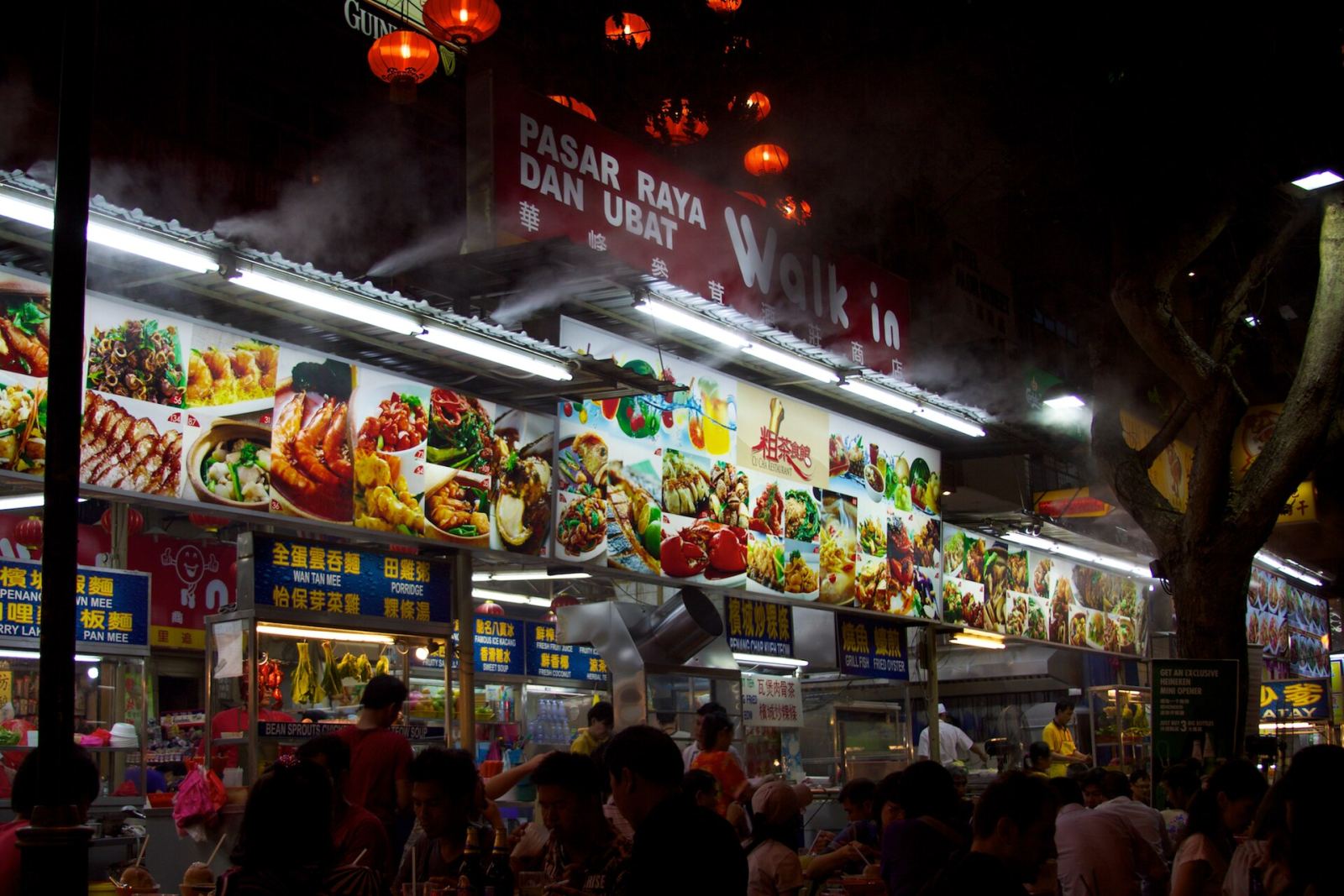
Vegetarian and non-seafood options are plentiful too, despite the street's seafood-heavy reputation — noodle stalls, satay stands, and Malay rice dishes are all well represented, so groups with mixed dietary preferences rarely struggle to find something for everyone within a few stalls of each other. Halal options are widespread throughout, reflecting Kuala Lumpur's majority-Muslim population, though a handful of stalls specifically serve pork and other non-halal dishes and are typically marked clearly to avoid confusion.
Seafood is arguably Jalan Alor's single strongest category, with tanks of live fish, prawns, and crabs displayed streetside so diners can pick their own before it's grilled or wok-fried to order. Beyond seafood, satay, char kway teow, and grilled chicken wings all have a strong reputation on the street, and it's genuinely common to see repeat visitors order the exact same dish from the exact same stall on every trip to Kuala Lumpur, a testament to how consistent quality has stayed at the more established spots.
With dozens of nearly identical-looking restaurants competing for the same crowd, a short walk up and down the street before committing to a table is worth it — look for busy stalls with mostly local customers, a reasonably reliable signal of quality on a street this dense with options. Menus with photos posted outside also make ordering considerably easier for first-time visitors unfamiliar with the dish names.
Portions on Jalan Alor lean generous and prices lean friendly, a combination that has helped the street hold onto its reputation as one of the best-value dining destinations in central Kuala Lumpur even as the surrounding Bukit Bintang district has grown steadily more expensive. Sharing multiple dishes across a table — the way most groups actually eat here — remains one of the most cost-effective ways to sample a genuinely wide range of the street's cooking styles in a single sitting, rather than committing to just one stall's menu.
Jalan Alor sits at the edge of Bukit Bintang, Kuala Lumpur's dense entertainment and shopping core, which means it's rarely a standalone destination — most visitors fold it into a broader evening that includes shopping at Bukit Bintang's malls or the nearby Pavilion KL. That proximity is part of the street's appeal: after a day of sightseeing or shopping, Jalan Alor offers an easy, low-commitment way to eat well without needing a reservation or dressing up.
Jalan Alor sits a short walk from the district covered in Bukit Bintang vs. KLCC: Where to Stay, making it an easy add-on to an evening based in either area. For more of the city's food scene, see Best Malaysian Street Food to Try in KL and Roti Canai in KL.
Bukit Bintang MTR/MRT and monorail stations both sit within a short walk of Jalan Alor, making it one of the easiest food streets in the city to reach by public transit. From most central KL hotels, it's also a manageable 10-15 minute walk, and the street itself is fully pedestrian-friendly once you arrive, packed tightly enough that navigating by car isn't a realistic option during peak dinner hours anyway.
Frequently Asked Questions
Weekends bring a noticeably younger, more international crowd to Jalan Alor compared to weeknights, when the balance tips further toward local office workers grabbing dinner on their way home. Neither version is more "authentic" than the other — the street has always served both audiences simultaneously, and that dual identity, rather than diluting the experience, is arguably what has kept Jalan Alor thriving decades after plenty of other Kuala Lumpur food streets faded.