Trastevere: Rome's Bohemian Neighborhood Across the Tiber, Explained
Medieval streets, a historic working-class identity, and the neighborhood most visitors call their favorite part of Rome — its history and how to see it well.

That local identity extends into a genuinely distinct culinary tradition, too. Trastevere and the old Testaccio slaughterhouse district across town are generally credited as the birthplace of Rome's quinto quarto ("fifth quarter") cooking style — dishes built around offal and other cuts once considered a butcher's throwaway share, transformed by necessity and skill into some of the city's most distinctive traditional cooking. Trattorias serving dishes like coda alla vaccinara (oxtail stew) and trippa alla romana (Roman-style tripe) remain genuinely common in the neighborhood, a working-class culinary inheritance that has survived the area's gentrification better than almost anything else about it.
Trastevere means "beyond the Tiber," and that river has shaped the neighborhood's identity for close to three thousand years — a separate, slightly apart district across the water from Rome's ancient center, with its own dialect, its own festivals, and its own fierce sense of local identity that survives even now that the area has become one of the most visited in the city. Narrow cobblestone lanes, ivy-draped facades in faded ochre and terracotta, and a genuinely lived-in feel have made Trastevere the neighborhood most visitors describe as their favorite part of Rome, even when they can't quite name a single monument that justifies the feeling.
Rome captured this side of the Tiber around 753 BC specifically to control the river on both banks, but for centuries afterward showed little interest in actually developing it — leaving Trastevere to grow on its own terms, settled early on by sailors, foreign traders, and communities that didn't quite fit into the more formal Roman city across the water. An embankment was eventually built under Emperor Augustus, but the neighborhood's real flourishing came during the Middle Ages, when it became a hub for travelers and merchants, and later a favored lodging area for Renaissance pilgrims: close enough to the Vatican to be convenient, far enough from the city center to be considerably cheaper.
Trastevere's modern reputation as Rome's bohemian quarter took shape in the 19th and 20th centuries, when artists, writers, and intellectuals were drawn to its narrow lanes and picturesque piazzas, and it solidified further in the 1960s and 70s, when the neighborhood became genuinely fashionable for its countercultural, artistic atmosphere. For most of that time, though, Trastevere remained a proud, working-class neighborhood at heart — it's only in roughly the last decade that gentrification has fully taken hold, bringing higher rents and a more polished restaurant scene. Longtime residents, the Trasteverini, still tend to see themselves as the last truly authentic Romans, a claim that carries real weight given how much of the historic center has become dominated by short-term rentals and tourist-facing businesses.
| Time | Atmosphere | Best For |
|---|---|---|
| Morning | Quiet, local, cafés filling with residents rather than tourists | Seeing the neighborhood as locals experience it |
| Afternoon | Moderate crowds, shops and piazzas active | Casual sightseeing and photography |
| Evening | Busiest; restaurants and bars fill up, piazza life at its peak | The classic Trastevere dinner-and-piazza experience |
| Late night (after 11pm) | Loud, youthful nightlife concentrated around a few piazzas | Bars and nightlife, expect noise if you're staying nearby |
Trastevere's charm comes largely from its unrenovated medieval streets, which means uneven cobblestones (sampietrini) throughout — often slick when wet and uncomfortable in anything but sturdy, flat shoes. Comfortable footwear matters here more than in most other parts of central Rome.
The Isola Tiberina, a small boat-shaped island in the middle of the Tiber, sits at the northern edge of Trastevere and has functioned as a place of healing since antiquity — a Temple of Aesculapius, the Roman god of medicine, once stood here, and a functioning hospital, Fatebenefratelli, still operates on the island today, continuing an unbroken medical association stretching back over two thousand years. It's connected to both banks by two of Rome's oldest bridges, and makes a natural, easy detour on the walk into or out of Trastevere proper.
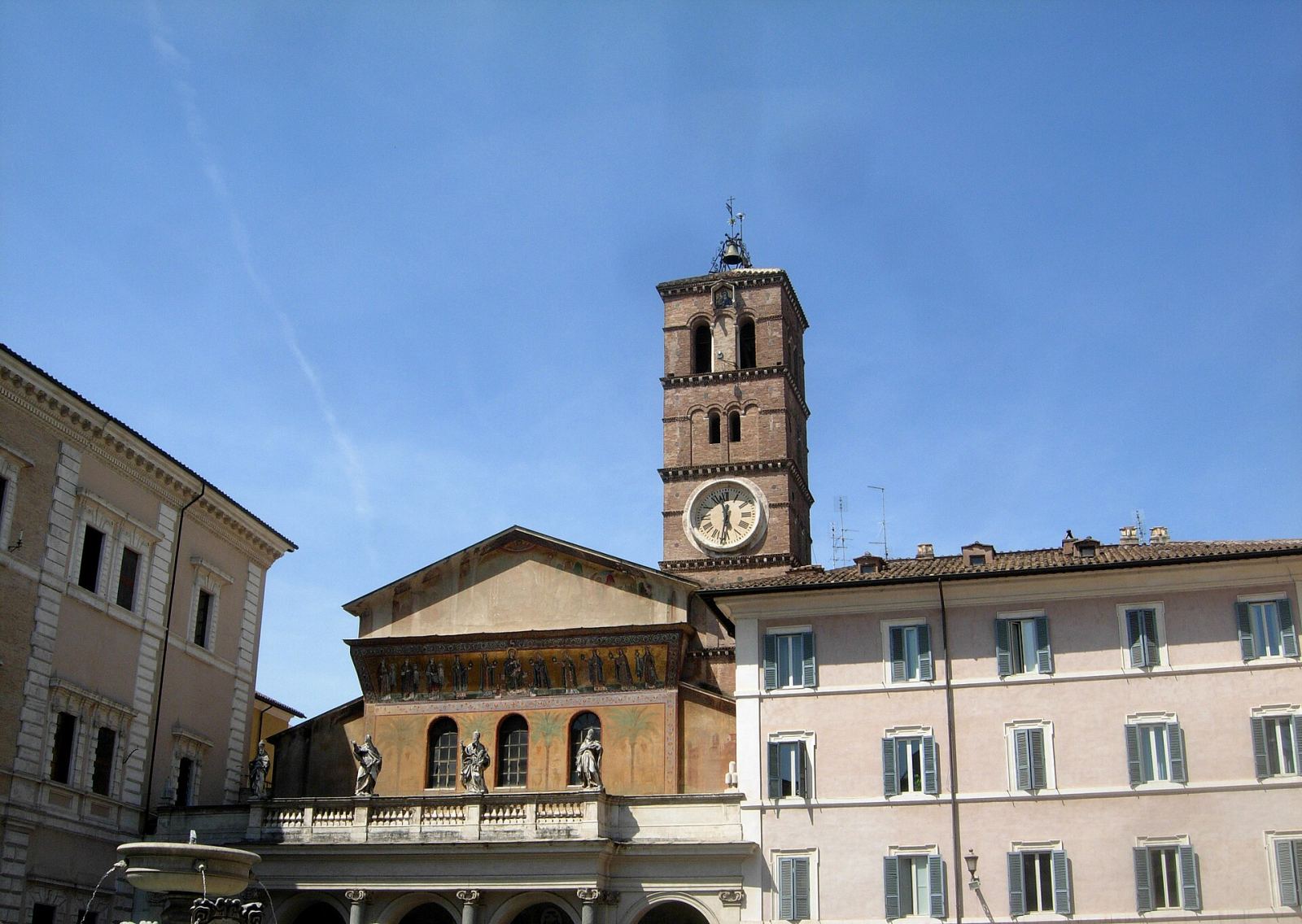
The Basilica of Santa Maria in Trastevere anchors the neighborhood both physically and socially — believed to be one of the oldest churches in Rome dedicated to the Virgin Mary, with a facade of striking gold-ground mosaics and an interior lined with ancient columns salvaged from earlier Roman buildings. The piazza in front of it, built around a fountain that may be even older than the church itself, functions as Trastevere's default meeting point and social hub at almost any hour, filled with students, residents, and street musicians rather than organized tour groups. Beyond the church, the neighborhood rewards aimless wandering more than almost anywhere else in Rome — its irregular medieval street grid means a five-minute walk in any direction turns up a new courtyard, ivy-covered doorway, or unmarked trattoria.
Trastevere sits an easy walk across the Tiber from Rome's historic center, making it simple to combine with sights like the Trevi Fountain or a broader day covered in How Many Days Do You Need in Rome? Its trattorias are also some of the best in the city for the food covered in our guide to Best Pasta and Trattorias in Rome.
There's no metro station directly in Trastevere, which is part of why it has retained a slower pace than more transit-accessible parts of central Rome. Tram 8 runs directly from Largo di Torre Argentina in the historic center to the heart of the neighborhood, and it's an easy 15-20 minute walk across the Ponte Sisto or Ponte Garibaldi bridges from the same area. Bus H also connects Trastevere to Termini station. Once there, the neighborhood is compact enough to explore entirely on foot.
Frequently Asked Questions
Even with all the change of the last decade, Trastevere on a weekday morning still slips back into something closer to its older rhythm — shutters going up on small grocers, residents greeting each other by name at the corner bar, laundry strung between buildings a few streets back from the main piazzas. It's worth building at least one unhurried, tourist-attraction-free hour into a Trastevere visit; the neighborhood rewards that kind of aimless time more generously than almost anywhere else in Rome.


