The Spanish Steps and Via del Corso: Rome's Grand Promenade, Explained
A 2,000-year-old Roman road, a Baroque staircase, and the evening ritual of the passeggiata — what to know before you go.

The word passeggiata itself deserves a note for visitors unfamiliar with the tradition: it's not simply "a walk," but a specific evening social ritual, typically taken in the hour or two before dinner, dressed reasonably well, moving at a deliberately unhurried pace through a central, sociable part of town. Via del Corso has served as one of Rome's primary passeggiata routes for generations, which is part of why the street can feel almost as crowded with strolling locals as with tourists on a pleasant evening — it's a genuine local custom playing out alongside the sightseeing, not a performance staged for visitors.
The Spanish Steps and the Via del Corso together form central Rome's grandest stage for the passeggiata — the Italian evening tradition of strolling to see and be seen — and between them they draw some of the largest, steadiest crowds anywhere in the city. The 135-step staircase climbing from Piazza di Spagna to the church of Trinità dei Monti is one of Rome's most photographed sights, while Via del Corso, the famously straight thoroughfare running north from the piazza, has been a central artery of the city for more than two thousand years, long before either the steps or the square existed.
Via del Corso is the older of the two by a wide margin: it began in 220 BC as a road built by the Roman censor Gaius Flaminius to link the city with the Adriatic coast to the north, part of the Via Flaminia. Its modern name comes from the horse races (corse) held along it during Carnival celebrations in later centuries. Piazza di Spagna and its steps came much later — the square takes its name from the Spanish Embassy to the Holy See, which moved into the nearby Palazzo di Spagna in 1647. The steps themselves weren't built until 1723-1725, funded by a bequest from a French diplomat but named for the surrounding Spanish square after decades of political wrangling between French and Spanish interests over what to do with the steep, undeveloped slope between the two piazzas.
At the foot of the steps sits the Fontana della Barcaccia ("Fountain of the Ugly Boat"), designed by Pietro Bernini — father of the far more famous Gian Lorenzo Bernini — and completed in 1627, predating the steps above it by nearly a century. The Keats-Shelley Memorial House, where English poet John Keats spent his final months and died in 1821, sits in the building immediately to the right of the steps and is now a small museum dedicated to the English Romantic poets. From the top of the steps, Trinità dei Monti offers one of the better free viewpoints over central Rome's rooftops, especially in the late afternoon.
| Time | Atmosphere | Best For |
|---|---|---|
| Early morning | Quietest window, before tour groups and shoppers arrive | Photos of the empty steps |
| Evening (passeggiata hours) | Busiest; Via del Corso fills with strolling crowds | Experiencing the area as Romans traditionally do |
| Weekday afternoons | Steady shopping crowds along Via del Corso and Via dei Condotti | Shopping |
| Golden hour | Best light on Trinità dei Monti's facade and the steps | Photography |
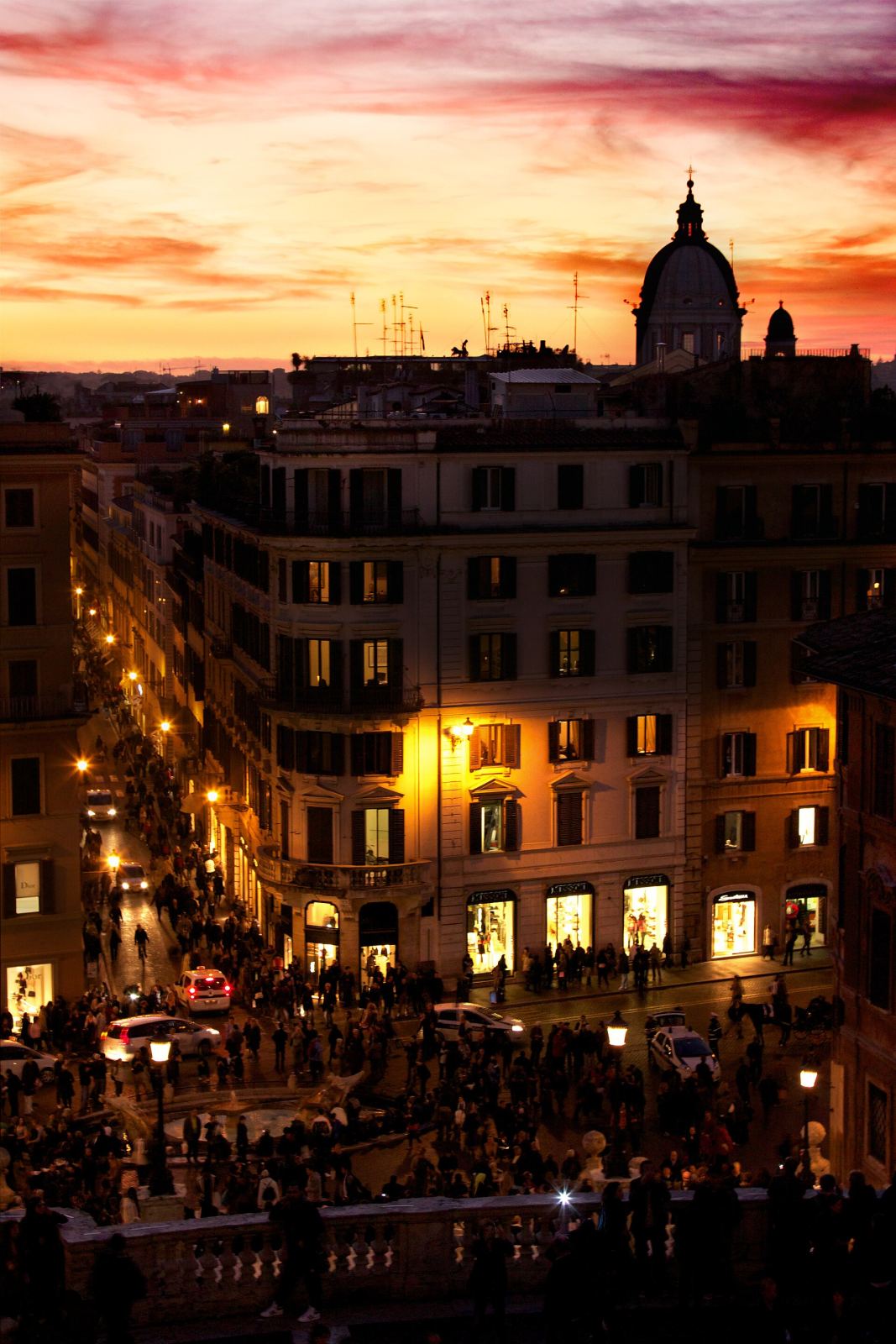
Since 2019, Rome has banned sitting, eating, and drinking on the Spanish Steps themselves, with fines ranging from €160 to €400 for violations — the rule was introduced to protect the marble from wear and litter after decades of visitors treating the steps as an outdoor picnic spot. Enjoy the view standing, or find a café seat nearby instead.
The staircase's design was the product of decades of political deadlock before it was ever built. For most of the 17th century, the steep, unpaved slope connecting the Spanish and French-controlled piazzas above and below sat undeveloped, with French and Spanish diplomatic interests unable to agree on a design or on whose patronage it should ultimately reflect. The compromise that emerged in the 1720s — a French-funded structure carrying the Spanish square's name — is part of why the steps' full official name barely gets used today; almost everyone, in every language, just calls them the Spanish Steps.
Via del Corso itself runs for about a mile north from Piazza Venezia to Piazza del Popolo, and functions as one of Rome's primary shopping streets, mixing mainstream fashion chains with the occasional historic palazzo. The genuinely upscale shopping — the Italian and international luxury houses most visitors associate with Rome — is concentrated instead on Via dei Condotti and the surrounding streets branching directly off Piazza di Spagna, sometimes called Rome's "shopping triangle." Together, the Corso and the streets around the Spanish Steps make up the single densest concentration of retail in the historic center.
The area sits within easy walking distance of the Trevi Fountain, making the two a natural pairing for a single afternoon. For broader trip planning, see How Many Days Do You Need in Rome?, and if an evening passeggiata leaves you hungry, our guide to Gelato in Rome covers exactly the kind of stop Romans traditionally make afterward.
Metro Spagna, on Line A, sits almost directly beneath the piazza and is by far the easiest way to reach the steps — you'll emerge via a long escalator practically at the top of the staircase. From most other parts of central Rome, it's also a comfortable 15-20 minute walk, particularly if you're already exploring on foot along Via del Corso or coming from the Trevi Fountain area nearby.
Frequently Asked Questions
Piazza del Popolo, at the northern end of Via del Corso, makes a natural bookend to a walk down the street from the Spanish Steps — a large, elegant square with twin Baroque churches and an Egyptian obelisk of its own, considerably less crowded than Piazza di Spagna despite its similar architectural pedigree. Walking the full length of the Corso between the two squares gives a genuinely useful sense of how central Rome's grand 17th-century urban planning connects one landmark to the next along a single straight line.


