Piazza Navona: Rome's Baroque Masterpiece, Built on an Ancient Stadium
Bernini's fountains, a two-thousand-year-old stadium footprint, and the famous (and mostly false) rivalry story behind it all.

The name "Navona" itself is debated among historians, with the most commonly cited theory tracing it back to "in agone" — a reference to the athletic competitions (agones) once held in Domitian's stadium — gradually slurred over centuries of everyday speech into "n'agona" and eventually "Navona." The nearby church of Sant'Agnese in Agone preserves the older form directly in its own name, a linguistic fossil sitting right alongside the physical one formed by the piazza's shape.
Piazza Navona's distinctive long, narrow, rounded-end shape isn't a design choice — it's a fossil. The piazza sits directly on top of the outline of Emperor Domitian's stadium, built around 86 AD to host Greek-style athletic competitions for the Roman public, and nearly two thousand years later, that stadium's elliptical footprint still defines the square exactly. Few places in Rome make the layering of the city's history quite so visible: a Baroque masterpiece of fountains, churches, and palazzi, built directly inside the ghost of an ancient sports arena.
The piazza's transformation into the Baroque showpiece it is today happened in the 17th century, when Pope Innocent X — whose family palazzo, Palazzo Pamphilj, faces onto the square — commissioned Gian Lorenzo Bernini and Francesco Borromini, the two dominant and famously rival architects of the era, to remake the space. The results are still the piazza's main draw: three monumental fountains and the church of Sant'Agnese in Agone, largely designed by Borromini, all combining into one of the most complete Baroque public spaces anywhere in the world.
The centerpiece is Bernini's Fontana dei Quattro Fiumi, the Fountain of the Four Rivers, unveiled in June 1651 — four colossal marble figures representing the great rivers of four continents known to Europe at the time: the Nile for Africa, the Ganges for Asia, the Danube for Europe, and the Río de la Plata for the Americas. An Egyptian obelisk rises from the fountain's center, a deliberate symbol of the Catholic Church's triumph over the pre-Christian, pagan world. At the piazza's southern end sits the Fontana del Moro, originally designed in 1575 by Giacomo della Porta and enhanced in 1653 when Bernini added its central figure of a Moor wrestling a dolphin, surrounded by four tritons.
| Time | Atmosphere | Best For |
|---|---|---|
| Early morning | Quiet, before street artists and crowds set up | Photos of the fountains without crowds |
| Midday-afternoon | Busiest; street artists, performers, and tour groups fill the square | People-watching and street performances |
| Evening | Restaurant terraces fill, fountains illuminated after dark | Dinner with a view, atmosphere |
| Off-season weekdays | Noticeably quieter than summer | A calmer visit to appreciate the architecture |
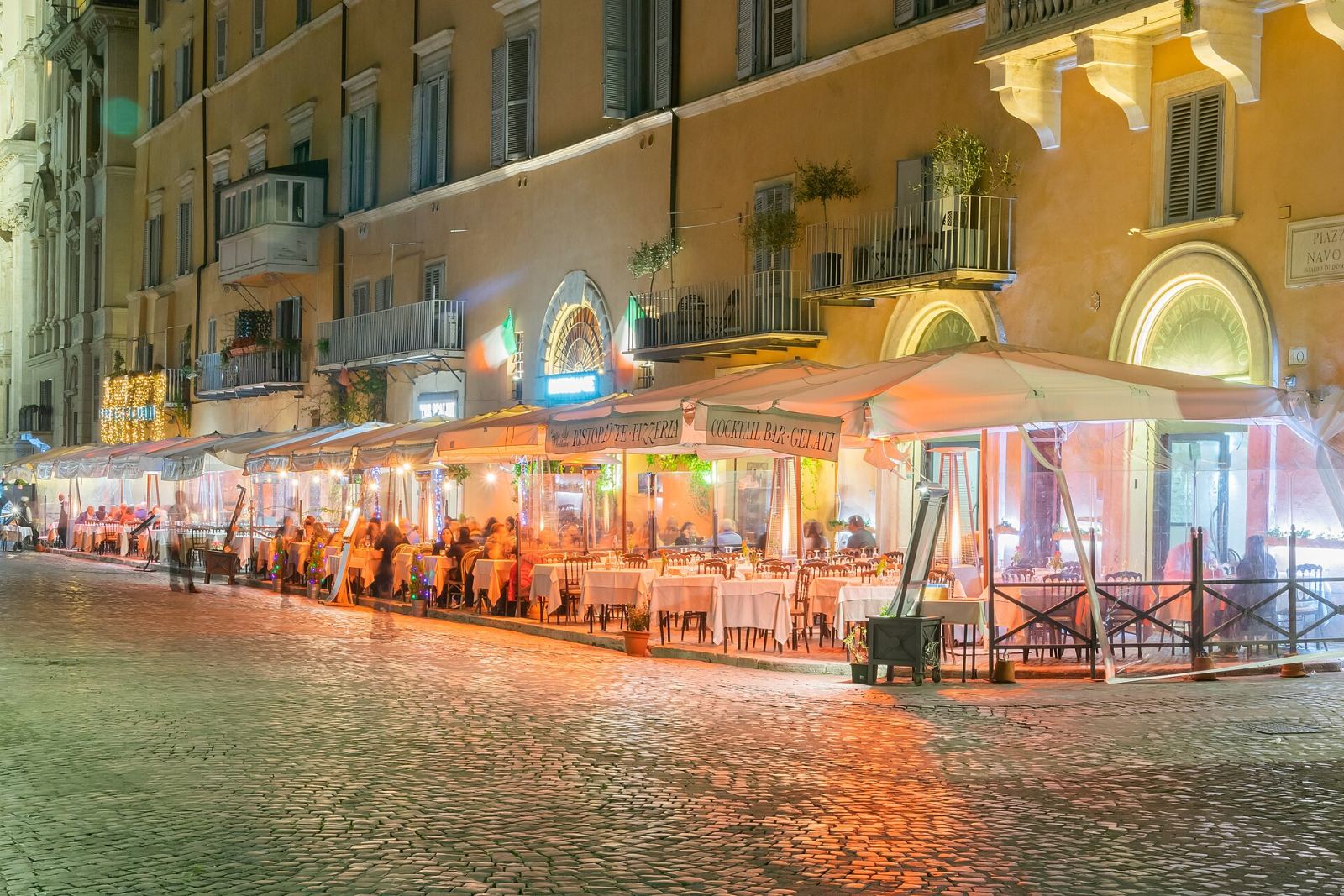
Sitting at a café table directly facing the fountains in Piazza Navona typically costs significantly more than the same coffee or drink a few streets away — you're paying for the view. It's a reasonable splurge for the atmosphere at least once, but don't expect Piazza Navona prices anywhere else nearby.
Street artists and portrait painters have set up along Piazza Navona's edges for generations, and while the quality varies widely, a handful of genuinely skilled caricaturists and quick-sketch artists still work the square daily, continuing a tradition that predates most of the surrounding restaurants by decades. The piazza also hosts a well-known Christmas market each December, when stalls selling ornaments, sweets, and traditional Befana-themed toys fill the square between the fountains — a seasonal tradition distinct from, and in some ways older than, the piazza's function as a year-round tourist draw.
A well-worn (and largely debunked) legend claims that Bernini designed the Nile figure on the Four Rivers Fountain with its arm raised to shield its eyes in horror from Borromini's supposedly unstable-looking church facade across the square — a colorful story about the two architects' famous professional rivalry, undercut somewhat by the inconvenient fact that Bernini's fountain was completed years before Borromini even began work on the church facade. True or not, the story captures something real about the intensity of Baroque Rome's architectural rivalries, and guides still tell it because it's a good one, even while acknowledging the timeline doesn't quite hold up.
Piazza Navona is a short walk from Campo de' Fiori, and pairing the two makes for a natural walking route through Rome's historic center. For the bigger picture on timing your visit, see How Many Days Do You Need in Rome?, and after admiring Bernini's fountains, our guide to Gelato in Rome points you toward one of the better-regarded gelaterias within a short walk of the piazza.
As with much of Rome's historic center, there's no metro station directly at Piazza Navona — the nearest useful stops are a 15-20 minute walk away. Most visitors reach it on foot from Campo de' Fiori, the Pantheon, or Largo di Torre Argentina, all within easy walking distance and typically visited together as part of the same historic-center walking route.
Frequently Asked Questions
For all its Baroque grandeur, Piazza Navona remains a genuinely functioning public square rather than a museum piece — children still chase pigeons around the fountain basins, locals cut through on their daily commute, and the surrounding cafés serve regulars alongside tourists every single day of the year. That everyday continuity, stretching back through the piazza's ancient stadium origins, its Baroque reinvention, and into the present, is arguably the most Roman thing about it: layers of history that never stopped being used, rather than a single frozen moment preserved behind glass for visitors to observe from a careful distance.


